Bruce Beasley
Killyboffin 1968
Reproduction of this image, including downloading, is prohibited.
Audio Description (01:38)
Full Audio Transcript (Expand)
Killyboffin
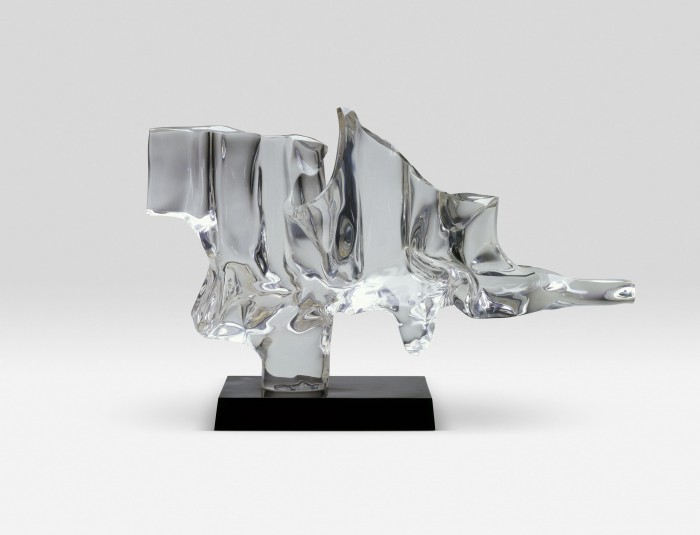
Bruce Beasley wanted to use light as the medium for his sculptures. He achieved this creative vision by casting acrylic into sculptures that are completely clear and let the light pass through from every direction. In 1968, he cast Killyboffin, which is just over two feet tall, three-and-three-quarters feet long, and a tad over one foot deep at its thickest. Unlike a flat glass window pane, this sculpture has curves, dips, puckers, folds, and waves that bend light so that the shape of everything beyond it gets distorted.
Understanding the shape of Killyboffin depends on what angle one approaches the artwork. There is a short, tubular stalk that opens up into the main shape, which is about 13 inches thick and resembles a sheet of not-perfectly-rectangular aluminum foil that has been crumpled up and partly flattened back out. Just as crumpled foil can never be fully flattened again by hand, this artwork is wrinkled. And though it resembles foil, it also seems like an ice sculpture because it is transparent, impossibly smooth and slick, and bits of it seem to be dripping down. Small spills slip off the front, and the left side narrows almost to a point, as if melting and starting to slide away.
The sculpture stands on a shiny black rectangular base and is positioned on a pedestal in front of floor-to-ceiling windows. Because the sculpture has no hint of color to it, the objects all around keep their true colors, whether the variety of trees outside, the gallery walls, or the or the color of any adjacent artwork.
On the title, Killyboffin, Bruce Beasley remarks, “The truth is that it is a name that I saw on one of the Washington State ferryboats. I thought it was a great name and would make a good name for a sculpture because it did not imply any context.”
Artwork Details
- Bruce Beasley
- b. 1939, Los Angeles, CA
- Killyboffin
- 1968
- cast acrylic
- 28 x 45 x 13 1/4 in.
- engraving around lower edge, verso: Beasley 68-1/6
- 2014.1.012
- Decade:1961-1970
- Medium:acrylic
- Movement:California Light & Space
- On view