Manuel Neri
Mujer Pegada Study No. 7 1984
Reproduction of this image, including downloading, is prohibited.
Audio Description (02:44)
Full Audio Transcript (Expand)
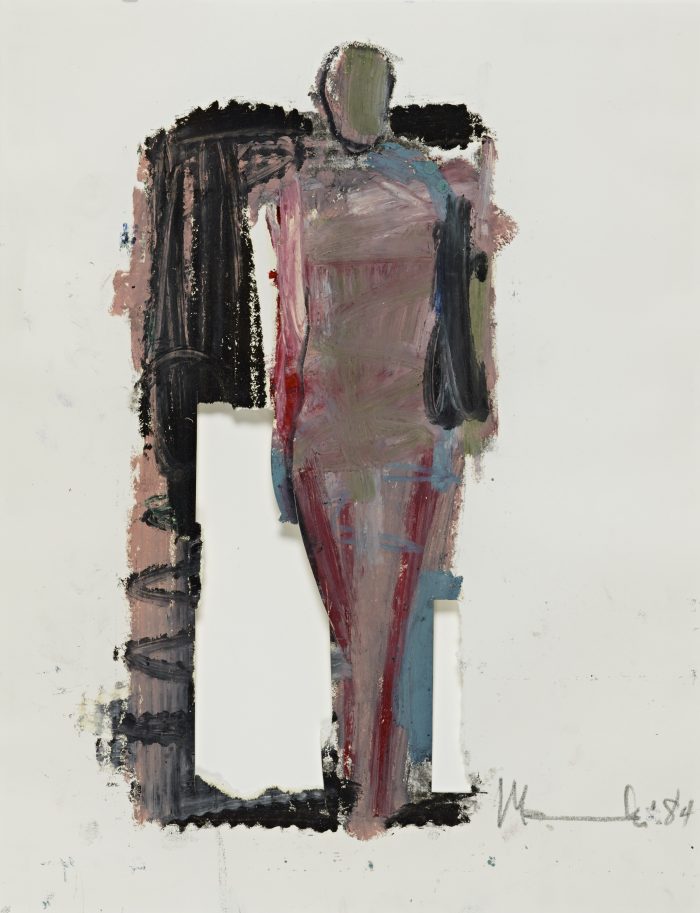
Manuel Neri’s Mujer Pegada Study No. 7 from 1984 is made with oil-paint stick, charcoal, and graphite on light beige paper, a little over 13 inches high by just over 10 inches wide. It is part of a series that includes studies number 2 and number 12. A female figure without a face stands at the center in front of a small section of wall with her right leg crossed over her left. The colors are deep and saturated: olive green, bright turquoise, cherry red, pale pink, white, and creamy peach oil, and jet-black charcoal. The oil-paint stick produces smooth lines without brushstrokes.
Cherry red and white were used top to bottom on the figure’s body, with all of the other colors added afterward as accents: short turquoise stripes here and there; most of her face veiled in olive green; wriggling, thick lines of the green down her abdomen; and her right arm in a sleeve of swooping black lines. Blending the cherry red and the white led to pink in some areas and streaks like striated muscle in others. The wall is mostly black, accented with peach all around and a light smudge of the green near her right arm.
The charcoal lines are the deepest, dark elements on the page. The top and bottom of the wall section have scalloped edges, giving it the feel of corrugated cardboard, though the paper is flat and smooth. Some of the charcoal lines may have been applied over wet oil paint; a squiggling line down the left side of the wall lightens and smears as it goes. The figure’s right foot is stepping over the bottom border, which looks like she is about to step off the page.
The paper with the figure is set on top of another, unmarked sheet of white paper. Neri cut and tore the top page around the figure’s body to create windows where the sheet below shows through. From her left hip to her foot, much of the wall section has been removed. The top and bottom of this window were torn. Neri traced the curves of her hip and leg on the right side of the window with his blade and also cut most of the window’s left border. A short, slender window near her right leg was taken out as well, cutting straight lines on the top, left, and bottom sides, and tearing on a diagonal for the window’s right side.
All around the figure and her wall can be found tiny paint dabs and smudges of charcoal, likely carried by the artist’s hand as he worked. Although Neri may have used graphite to initially sketch the shape of the figure, the only pencil showing in the artwork is his signature near the lower right corner: A sharp M, a long horizontal line, and E R I, then 84.
3 Mujer Pegada Studies, 1984 and 1985
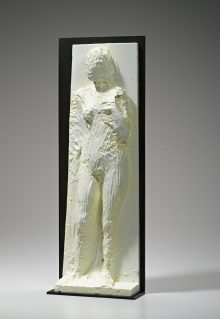
These three studies relate to a major series of relief sculptures that Neri initiated in the 1980s, including the nine maquettes installed on the opposite side of this gallery. The title, Mujer Pegada, translates from Spanish as “glued” or “attached woman,” referring to the way the female figures appear encased in the walls behind them. Neri reveals the figures in these drawings using both additive and subtractive processes: he builds the images up with oil-stick, thickly applied, and carefully cuts and tears the paper away to articulate certain elements. The distinction between figure and ground is complicated, as the body and the substrate are worked with equal vigor. Fingerprints remind us of the artist’s hand in his process.
-Sidney Simon, PhD ’18
Artwork Details
- Manuel Neri
- b. 1930, Sanger, CA
- d. 2021, Sacramento, CA
- Mujer Pegada Study No. 7
- 1984
- Oil-paint stick, charcoal, and graphite on paper.
- 13 5/8 x 10 5/8 in.
- 2017.2.11
- Decade:1981-1990
- Medium:charcoal, graphite, oil
- Movement:Bay Area Figuration
- Currently not on view


![Mujer Pegada Study [Gustavo No. 12], 1985](https://anderson.stanford.edu/wp-content/uploads/2017/07/MN.1985.DWG_.031-220x300.jpg)