Manuel Neri
Mujer Pegada Study No. 2 1984
Reproduction of this image, including downloading, is prohibited.
Audio Description (02:42)
Full Audio Transcript (Expand)
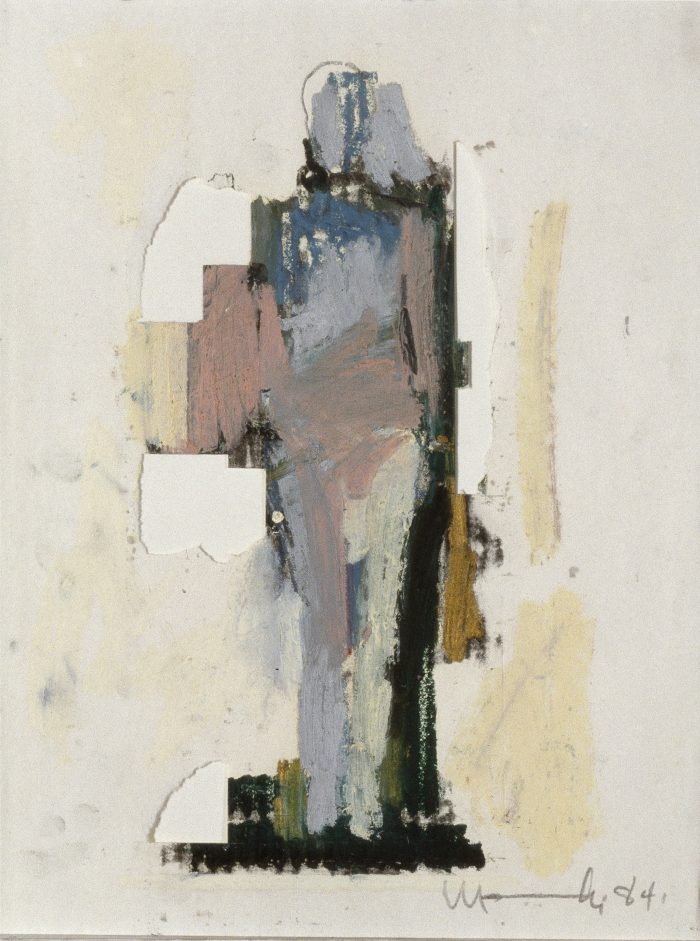
Mujer Pegada Study No. 2 from 1984 joins other related studies from a series by Manuel Neri. This artwork was made with oil-paint stick, charcoal, and graphite on light beige paper just a little over 13 inches high by a little over 10 inches wide. The oil-paint stick was used to create wide, thick lines with texture like a crayon and no brush strokes. Neri used peachy-mauve, steel blue, light gray, flaxen yellow, olive green, umber, and copper. Jet-black charcoal was added to create shadow-like accents.
At the center is a female figure standing with her left knee slightly bent. The outline of her head is a thin pencil line, and the rest of her is made of blocks and wide squiggles of color. Like the other studies in the Mujer Pegada series, she is flush against a small segment of wall, this one deep black. Neri’s figures often lack faces and parts of limbs. In this study, the chunky colors make it hard to tell whether anything is missing from the woman’s body or has simply been abstracted or obscured. Her face is half gray splotch and half stripes of steel blue with a wide gray shadow to the right of her head. Her neck and shoulder are shadowy in umber oil and black charcoal. Her body, arms, and legs are more alternating patches, stripes, and smears of all of the colors, giving the impression that she is dressed in an outfit that would not have been at all out of place in the 1980s, though these colors are much more subdued than popular bold color-block clothing of the time.
Neri also took advantage of the space around the figure and the wall. He placed the paper he painted over a completely blank second page. He opened up four variously-shaped windows in the top sheet by cutting and tearing to reveal the blank page below. Each window has some straight edges and sharp corners as well as organic, curving sides where the torn fibers of the paper are soft and feathery. There is one long, curvy window from the height of the figure’s ear to her hip on the right. The other three are on the left: one by her shoulder, one by her hip, and one near her feet. Beyond the figure’s body, the wall, and the windows are where the flaxen yellow is most prominent: several smudges float around her, pale and foggy on the left, and darker and thicker on the right. All around, but especially on the left, can be found little gray streaks and ovals like fingerprints. At the bottom right corner, the artist signed his name in pencil: a capital M, a long line that connects to E R I, and 84.
3 Mujer Pegada Studies, 1984 and 1985
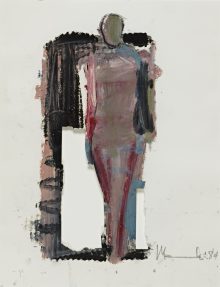
These three studies relate to a major series of relief sculptures that Neri initiated in the 1980s, including the nine maquettes installed on the opposite side of this gallery. The title, Mujer Pegada, translates from Spanish as “glued” or “attached woman,” referring to the way the female figures appear encased in the walls behind them. Neri reveals the figures in these drawings using both additive and subtractive processes: he builds the images up with oil-stick, thickly applied, and carefully cuts and tears the paper away to articulate certain elements. The distinction between figure and ground is complicated, as the body and the substrate are worked with equal vigor. Fingerprints remind us of the artist’s hand in his process.
-Sidney Simon, PhD ’18
Artwork Details
- Manuel Neri
- b. 1930, Sanger, CA
- d. 2021, Sacramento, CA
- Mujer Pegada Study No. 2
- 1984
- Oil paint stick, charcoal, and graphite on paper.
- 13 5/8 x 10 5/8 in.
- 2017.2.09
- Decade:1981-1990
- Medium:charcoal, graphite, oil
- Movement:Bay Area Figuration
- Currently not on view


![Mujer Pegada Study [Gustavo No. 12], 1985](https://anderson.stanford.edu/wp-content/uploads/2017/07/MN.1985.DWG_.031-220x300.jpg)